
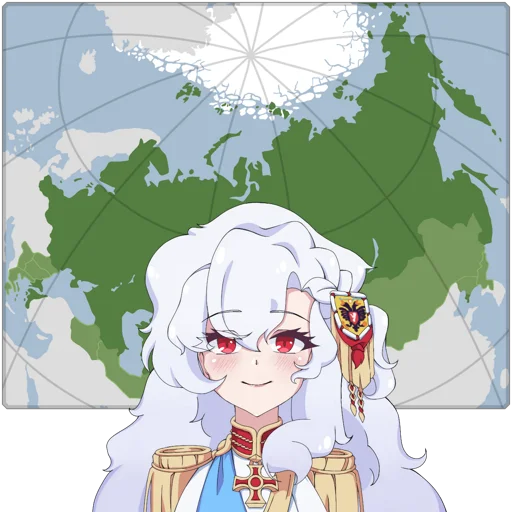
Pretender: Anastasia Nikolaevna Romanova Franziska Schanzkowska
A claim to have survived where the rest of the family perished. A person’s whose identity was as solid as gas. All they know is that they’re the Grand Duchess of the Russian Empire. Whether she knew she was lying or not is up to debate.
servant profile

Parameters
Strength: C
Endurance: C
Agility: C
Mana: A
Luck: A+++
NP: —
Class Skills
Riding D
Territory Creation C+++
Camouflage B+
Item Construction D-
Independent Action A++
Madness Enhancement EX
Personal SkillsNyet Lyubvi A+: Charisma which convinces those that ‘Anastasia' meets of her identity aside from the normal benefits of charisma. Even those who regularly interact with the real Grand Duchess are fooled. Should she meet the real Grand Duchess, it is unknown what would occur.Chrezvychaynaya Prerogativa (Fake) C: A skill normally associated with Ivan, ‘Anastasia’ gains a weaker version of the skill, because if she managed to convince enough people back when she was alive, and if the Soviet Union fell, she could’ve become Tsarina.Sudno EX: With her unique disposition and background, technically she would’ve been the perfect container for Anastasia should she have been used as a vessel in a grail war during a time she was alive. This status sticks with her even now, giving ‘Anastasia’ as much power as the real one, if not more due to the greater amount of mystery surrounding ‘Anastasia’Mgnovennoye Razrusheniye —: A skill that can enrapture those not careful. ‘Anastasia’ had far greater ease with men than the real grand duchess, so her already enhanced supernatural beauty from being a servant is enhanced for those who hold a romantic interest in the real Anastasia.Skazochnyy Kontrakt E: The real Anastasia has Viy, the fairy contracted to the Romanov family. Meanwhile 'Anastasia' has access to weaker nature spirits to use who took pity on her.
Noble Phantasm
Imperskaya Avtorizatsiya EX: Imperial Authorization is a Noble Phantasm that marks all land within 100 kilometers as 'Anastasia's' Territory, making her as strong as she would've been in either Russia or her homeland of Germany as a servant. This would allow her stats to dramatically increase and match any servant in their own home territory, with all her parameters increasing to a drastic degree.Arsenal Rodiny A++: 'Anastasia' gains access to munitions, weapons, and vehicles produced by the Russian state or its analogs that were made during her life time. Anything from swords, to AK-47s, to Su-27s are all available to her due to that. The more complicated the weapon is, the higher ranked it counts as a Noble Phantasm.
History

Anna Anderson (born Franziska Schanzkowska; 16 December 1896 – 12 February 1984) was an impostor who claimed to be Grand Duchess Anastasia of Russia. Anastasia, the youngest daughter of the last Tsar and Tsarina of Russia, Nicholas II and Alexandra, was murdered along with her parents and siblings on 17 July 1918 by Bolshevik revolutionaries in Yekaterinburg, Russia, but the location of her body was unknown until 2007.In 1920, Anderson was institutionalized in a mental hospital after a suicide attempt in Berlin. At first, she went by the name Fräulein Unbekannt (German for Miss Unknown) as she refused to reveal her identity. Later, she used the name Tschaikovsky and then Anderson. In March 1922, claims that Anderson was a Russian grand duchess first received public attention. Most members of Grand Duchess Anastasia's family and those who had known her, including court tutor Pierre Gilliard, said Anderson was an impostor but others were convinced she was Anastasia. In 1927, a private investigation funded by the Tsarina's brother, Ernest Louis, Grand Duke of Hesse, identified Anderson as Franziska Schanzkowska, a Polish factory worker with a history of mental illness. After a lawsuit lasting many years, the German courts ruled that Anderson had failed to prove she was Anastasia, but through media coverage, her claim gained notoriety.Between 1922 and 1968, Anderson lived in Germany and the United States with various supporters and in nursing homes and sanatoria, including at least one asylum. She emigrated to the United States in 1968. Shortly before the expiration of her visa she married history professor Jack Manahan, who was later characterized as "probably Charlottesville's best-loved eccentric". Upon her death in 1984, Anderson's body was cremated, and her ashes were buried in the churchyard at Castle Seeon, Germany.After the collapse of communism in the Soviet Union, the locations of the bodies of the Tsar, Tsarina, and all five of their children were revealed. Multiple laboratories in different countries confirmed their identity through DNA testing. DNA tests on a lock of Anderson's hair and surviving medical samples of her tissue showed that her DNA did not match that of the Romanov remains or that of living relatives of the Romanovs. Instead, Anderson's mitochondrial DNA matched that of Karl Maucher, a great-nephew of Franziska Schanzkowska. Most scientists, historians and journalists who have discussed the case accept that Anderson and Schanzkowska were the same person.